Source integrity
UTF-8 processing and CRC-16 framing
Complex-baseband software simulator
A baseband wireless communications engineering simulator.
Trace a message through coding, constellation mapping, OFDM, modeled channels, receiver equalization, and recovery—across the described end-to-end software subset.
01 / Signal path
The described core link connects framing to recovery. Each transformation is explicit; every boundary remains visible.
UTF-8 text
Framed bits
Coded bits
Complex symbols
Transmit samples
Impaired samples
Equalized symbols
FIG. 01 Explanatory pipeline diagram. It describes connected software stages, not timing or measured performance.
02 / Described core
The supplied project description identifies these stages. This page does not independently verify the implementation or its results.
UTF-8 processing and CRC-16 framing
Hamming(7,4) and block interleaving
BPSK through 256-QAM
Pilot-bearing OFDM, IFFT/FFT, cyclic prefix
AWGN and flat Rayleigh/Rician models
Pilot estimation with ZF and MMSE
This is a mathematical complex-baseband simulation—not an RF transmitter or receiver. It has not been verified for LTE, 5G, or NR standards compliance.
03 / Engineering architecture
The simulator separates interaction, typed request handling, simulation orchestration, signal processing, and result delivery.
Configuration + visualization
Validated request / response
End-to-end pipeline
Numerical processing
Structured simulation result
Database workflows are not implied by this architecture.
Advanced modules may exist independently without being connected to the main pipeline.
04 / Modulation + OFDM
Normalized BPSK, QPSK, 16-QAM, 64-QAM, and 256-QAM mapping feeds basic pilot-bearing OFDM with IFFT/FFT and cyclic prefix handling.
05 / Channel + receiver
Advanced multipath and synchronization correction are not established as part of the integrated end-to-end link.
06 / Metrics + reproducibility
Metrics are calculated from simulation output. They describe a finite software run—not RF hardware or network service.
Incorrect recovered bits divided by compared bits.
Incorrect detected symbols divided by compared symbols.
Difference between received and reference constellation points.
A model-derived waveform rate—not network or hardware throughput.
Wall-clock execution time for the configured simulation.
A supplied random seed makes channel runs deterministic. Finite samples still limit how confidently a single result represents long-run behavior.
07 / Interactive architecture explorer
Select a stage to see its role, contract, assumptions, and current limit.
Convert a UTF-8 message to bits and append CRC-16 framing for error detection.
08 / Demo + project gallery
Only owner-supplied project media belongs here. No mock screenshots, synthetic dashboards, or implied measurements.
An owner-supplied walkthrough can be connected when available.
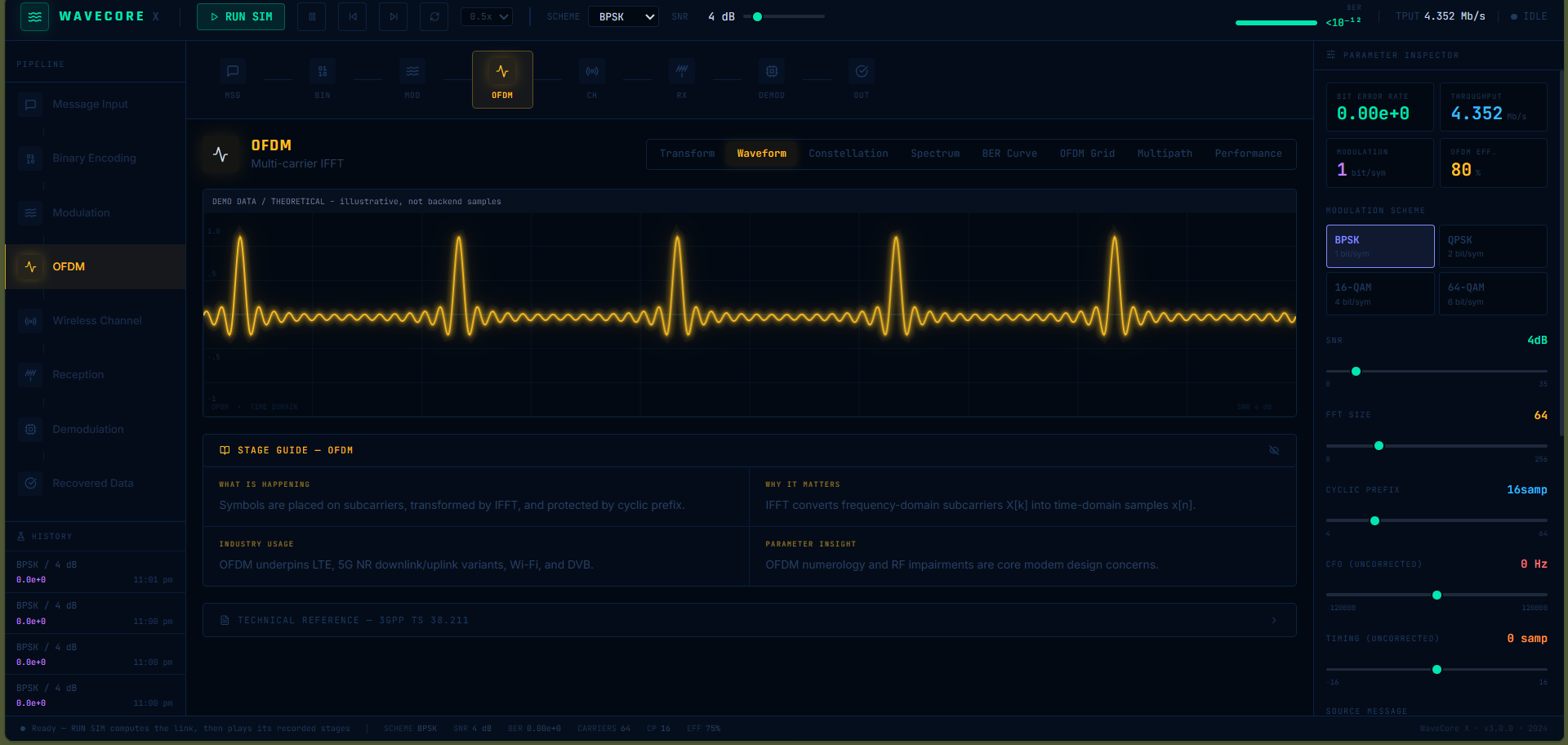
Owner-supplied capture of the WaveCore X simulator: pipeline stages, waveform view and parameter inspector.
09 / Validation + limitations
Validation maturity is a ladder. The supplied site describes a software model; no independent test evidence or measured hardware results were supplied here.
10 / Documentation
These links navigate to the corresponding technical sections on this public product page. External project documents can replace them when supplied.
11 / Roadmap
12 / ENGINEERING BLOG
A three-part engineering series following the signal from transmission through the channel to recovery.
EXPLORE BLOGContinue in the simulator
Configure the chain, run the software model, and inspect the resulting receiver metrics.